
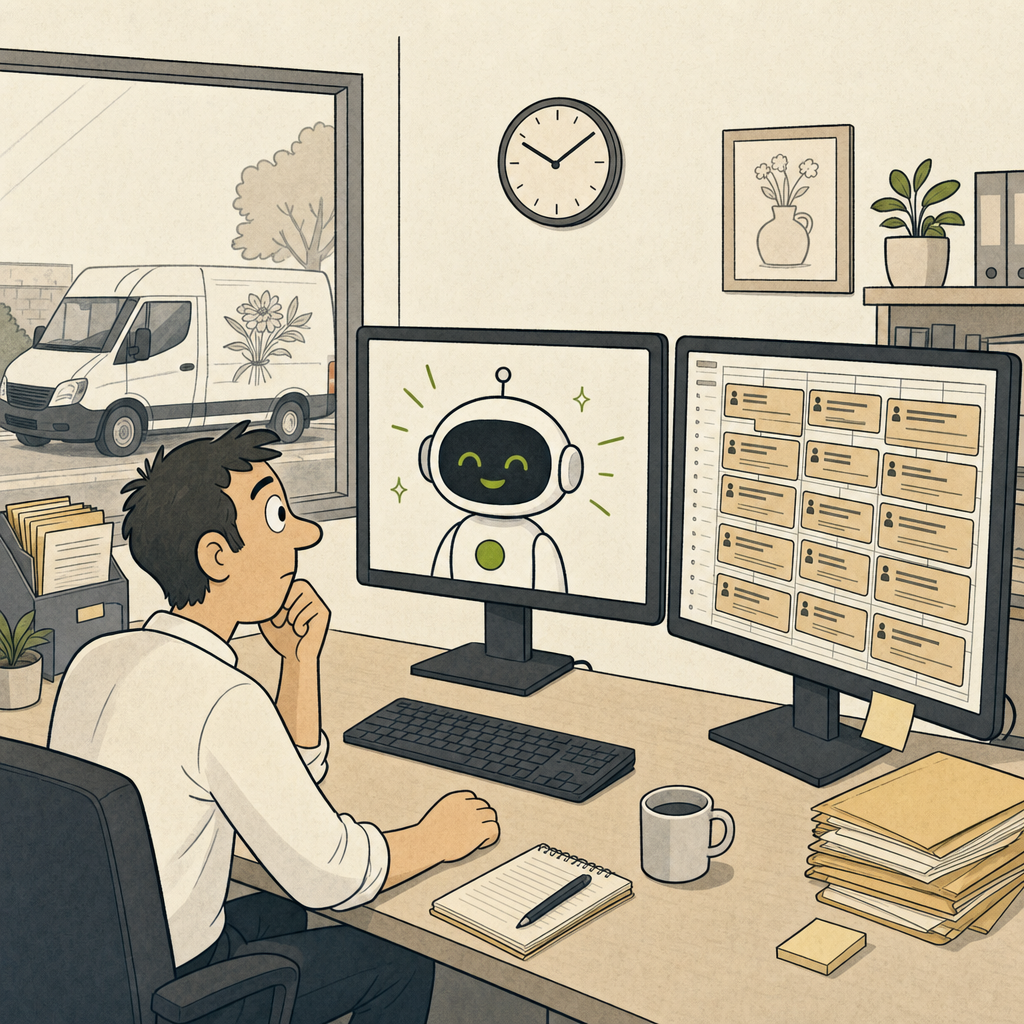
My uncle Derek ran a florist delivery round out of Morley for about twenty years. Roses, lilies, the occasional elaborate funeral arrangement that required three men and a tarpaulin. In 2009, flush with a decent inheritance and a dangerous amount of confidence, Derek sold his tired Transit and bought a brand-new Iveco Daily — the long-wheelbase model, refrigerated, with a reversing camera and a stereo that could genuinely rattle windows. He was very proud of it. He drove it home on the Friday, parked it outside number fourteen Cranmore Crescent, and on the Monday morning set off on precisely the same route, in precisely the same order, calling at precisely the same florists, at precisely the same time, as he had done for the previous decade and a half. The van was objectively quicker. Derek was not a second faster.
He sold the business three years later. "It were a good van," he told me, at a family barbecue in Rothwell that I'm not sure I was officially invited to. "Just couldn't ever figure out what to do with the extra time." He meant it as a joke. He did not know he was describing, with accidental precision, the central crisis of enterprise AI deployment in 2026.
Which brings me, against all odds, to Boston Consulting Group's latest workforce survey — and a number that should make any business owner put down their coffee. BCG's fourth annual Global AI at Work Survey, based on 11,749 employees across 14 markets, found that 42% of frontline workers who use AI regularly are saving upwards of a full working day per week — yet 66% receive no guidance on what to do with that time, and more than half don't redirect it to strategic work. A full day a week, evaporating. Our position at Finnwood is straightforward: rolling out AI tools without redesigning how work actually gets done is exactly what Derek did. Faster van. Same roads. Smaller margin.
The BCG report, published on 3rd June this year and titled — with a bluntness that consultant reports rarely manage — AI at Work: Strategy Matters More Than Tools, is quietly devastating if you read it carefully. Two-thirds of workers say they receive little or no guidance on how to reinvest recovered time, and the hours that are saved evaporate into busywork, informal tasks or simply expanded workloads — rather than going into anything that creates actual business value. The time isn't being stolen. It's being left on the kitchen table, like Derek's reversing camera display, which he never once looked at because he already knew the back of his own driveway. BCG's own data shows that companies with a clear AI strategy see 25 percentage points more measurable impact from AI than those without one — while companies that simply buy better tools, without the strategic framework, see only five points more impact. Five. You could get five points of improvement by buying everyone a slightly better chair.
None of this is happening in a vacuum. Torsten Slok, the chief economist for Apollo Global Management, has argued in a recent blog post that there is a growing and visible gap around AI-enhanced productivity — and that outside the tech sector, you basically cannot see it at all. His data shows that despite profit margins for the Magnificent Seven rising from around 15% to 25% between the first quarters of 2023 and 2026, profit margins for the rest of the S&P 493 have hovered unmoved around 10%. Somewhere in Mayfair, a man in a very good suit looked at those numbers and used the phrase "painful repricing." Slok himself wrote that "equity markets priced for instant earnings growth will face a painful repricing if the productivity hockey-stick takes five years rather than five months." That is the polished, institutional way of saying: the market is betting on a payoff that most businesses have not yet delivered, and the clock is ticking. For the owners of SMEs in Yorkshire reading this on a Sunday morning, the implications are more immediate: if your AI subscription is going up and your output isn't, you are funding someone else's margin expansion.
Then there is the problem that nobody wants to name at the all-hands meeting. BetterUp Labs & Stanford's Social Media Lab coined the term "workslop" in a September 2025 Harvard Business Review article, to describe AI-generated content that masquerades as good work but lacks the substance to advance a task. Their survey of 1,150 full-time workers found that 41% had received workslop in the preceding month, with each incident requiring an average of one hour and 56 minutes to sort out. Do the arithmetic on your own team. The Stanford researchers estimated these incidents carry an invisible tax of $186 per person per month — and for an organisation of 10,000 workers, given the prevalence of workslop, that yields over $9 million a year in lost productivity. This is the peculiar alchemy of under-managed AI: it saves your staff an hour, they spend ninety minutes fixing a colleague's AI-generated nonsense, and you end up further behind than when you started. It is like watching a dog operate a revolving door — a great deal of motion, accompanied by absolutely no net progress.
The BCG report is at least honest about where the fault lies. Only one-third of frontline employees say their leadership's communications about AI are clear, and only 28% "see a strong connection between what leaders say and what the organisation actually does." That gap — between the announcement and the instruction, between the licence purchase and the workflow redesign — is where productivity goes to die. BCG puts it plainly in their own slide deck: adoption tells you that people use AI, not whether it pays off, and the time individuals save leaks out of the organisation unless it is tracked and deliberately reinvested. BCG's own lead author, David Martin, told Fortune that many organisations simply handed AI to everyone regardless of position, and are now confronting the question of what the actual business case was supposed to be. The question, it turns out, should have been asked before the invoice was paid.
Derek eventually did redesign his route — four years after buying the Iveco, at the insistence of his accountant, using nothing more sophisticated than a piece of A3 paper and a felt-tip pen. He cut forty minutes off every morning by Tuesday. He still talks about it as if he invented logistics. The van, as it happens, was never the problem. If you have handed your team an AI tool and are waiting for the P&L to move, come and talk to us at Finnwood before you buy a second van. The route is the thing.