
There is a moment, well known to anyone who has ever bought a bread maker, when the appliance quietly migrates from the worktop to the back of a high shelf without anyone officially deciding anything. You didn't give up on it. You just stopped reaching. The bread maker sits up there now, between a box of mystery cables and a plug converter from a 2009 trip to Florida, radiating the particular dignity of things that cost too much to throw away. You paid good money for that machine. You have, in the eighteen months since, purchased eleven loaves of Warburtons.
My uncle Derek — not the brother-in-law Derek, a different Derek entirely, which tells you something about that side of the family — bought a top-of-the-range bread maker off the shopping channel on a wet Sunday in February 2019. Came with three attachments, a recipe book the size of a telephone directory, and a DVD. A DVD. He used it four times. The fourth time, it produced something that split down the middle and smelt of warm cement, and that was that. The machine went to the high shelf. The recipe book went in the recycling. The DVD, nobody could find a DVD player for anyway. Derek will tell you, if you ask him, that he didn't get on with the yeast.
Which brings me, against all odds, to Microsoft's organisational restructuring department — and to why the most revealing thing a software company has done this summer is not sacking people, but hiring them to explain its own product.
This week, Microsoft cut 4,800 jobs, just over 2% of its global workforce, citing a need to revamp its sales and consulting division to keep pace with a rapidly changing tech industry. About 1,600 of those cuts hit the Xbox division, where the gaming division's new head said the business needed a "reset" and that its profit margin had declined to 3%. The official line is that AI is reshaping — not replacing — the workforce. You are invited to form your own view on that framing. Microsoft's position is that some roles simply no longer make sense in their current form. This is the corporate equivalent of saying the bread maker made you reconsider your relationship with carbohydrates.
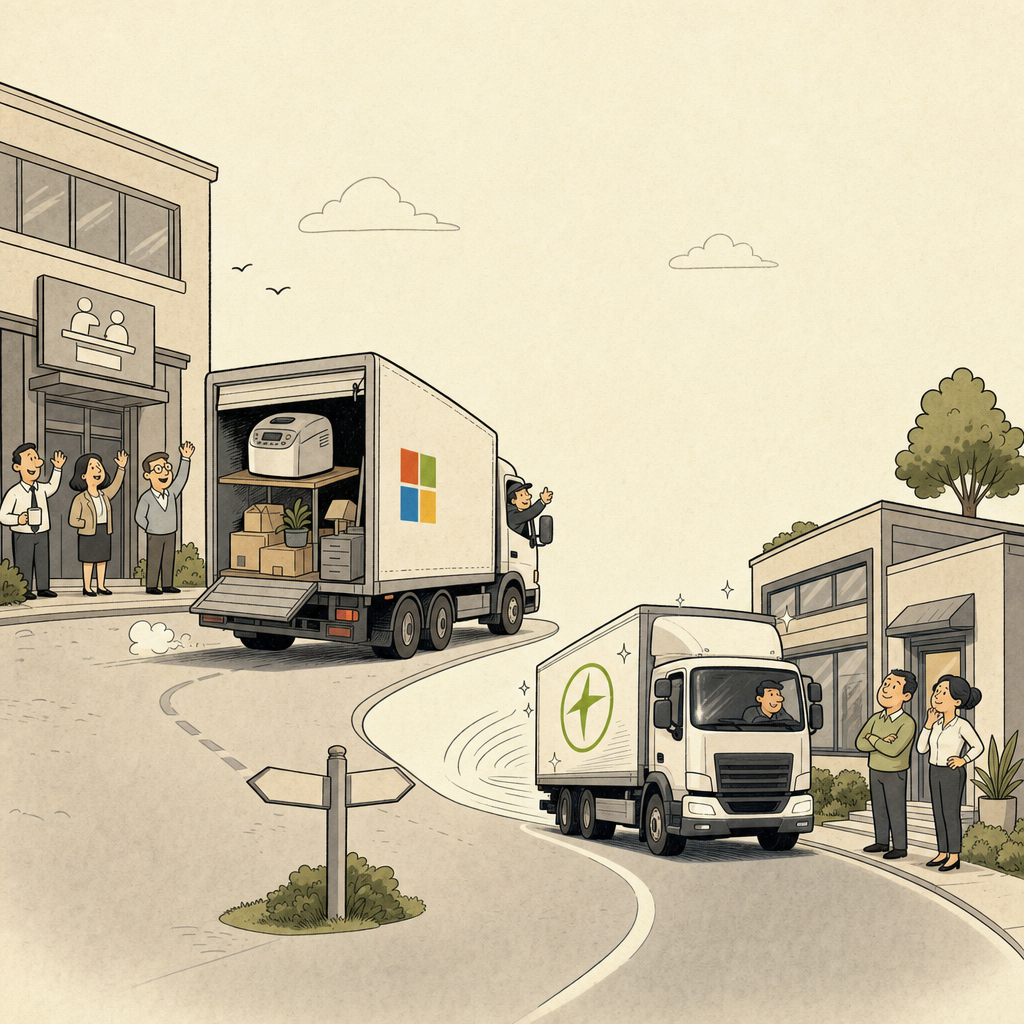
The more interesting number runs in the opposite direction. The cutbacks build on last week's launch of the Microsoft Frontier Company, a $2.5 billion initiative to embed 6,000 engineers inside customers to deploy AI. The goal is to move away from a traditional sales-and-consulting model toward engineers working alongside clients. Read that again: the world's largest software company has just created a 6,000-person unit whose entire job is to go into businesses and help them actually use the software the company already sold them. That is not a product launch. That is an admission. Somewhere in Redmond, someone looked at the adoption data, put the lid back on their coffee, and said: we need to send people round.
Because the adoption data is, to use the technical term, grim. Less than 5% of Microsoft's half a billion commercial Microsoft 365 customers pay for Copilot features — and of the ones who do pay, only 20 to 30 percent open Copilot on a weekly basis, meaning Copilot's weekly-active footprint inside Microsoft 365 is somewhere close to 1% of the entire customer base. Microsoft has wired this thing into Word, Excel, Outlook, Teams, and the Windows taskbar itself. One percent. The bread maker, it turns out, is on a very long shelf. Even organisations that invest heavily in Copilot licences frequently find adoption plateauing within weeks of deployment. The tool gets tried, it doesn't immediately feel transformative, and people revert to existing workflows. This is not a technology failure — it is a plan failure. Specifically, the failure to have one. We ran a whole column on this a few months ago, in the context of AI tools and faster vans. The shelf problem and the van problem are the same problem.
The financial backdrop is worth having on record. Microsoft's stock fell nearly 23% in the first half of 2026, its worst first-half showing since 2022, as investors worry about whether its AI products will pay off. The company issued a $190 billion spending projection for 2026 that massively surpassed expectations. The wider industry has seen close to 154,000 people lose their jobs just in the first half of 2026, with Meta, Oracle, Amazon, and Cognizant all cutting thousands of workers. The pattern across the lot of them is the same: cut the headcount that sells things, hire the headcount that makes things work. That is the business acknowledging, in the only language that counts, that implementation is hard. Not conceptually hard. Specifically, practically, expensively hard — the kind of hard that requires a $2.5 billion dedicated unit and 6,000 engineers with their sleeves rolled up.
For a business owner in Yorkshire considering whether to add Copilot licences to next year's budget, the lesson is not "don't bother." The lesson is: budget the implementation alongside the licence, or you are paying for a bread maker you will never use. Sustained weekly active use in real-world rollouts typically settles around 30 to 55% of purchased seats in the first year, and effective cost per active user runs roughly 1.8 to 3 times the list price once idle seats are counted. Cohorts with a named task and manager follow-up hold use two to three times higher than broad all-staff rollouts. The tools are not magic. Organisations that invest in structured, expert-led training get results, and those that skip it don't. Microsoft knows this well enough that it has now bet two and a half billion dollars on it.
Derek — the bread maker Derek — did eventually get back to it. Last Christmas, my cousin found him on page 47 of the recipe book, cross-referencing yeast quantities, with the machine plugged in on the worktop for the first time in six years. He'd had someone round to walk him through it. One afternoon. Turned out fine. The bread was decent, the cement smell never came back, and he now makes a white sourdough on Saturdays that he is insufferably pleased about. The machine didn't need replacing. It needed a plan. If you've got Copilot licences sitting on the metaphorical high shelf, give Finnwood a ring — we'll sort the yeast.