
There is a moment in every episode of Thunderbirds when the Tracy brothers are already sprinting across the palm-tree lawn toward Thunderbird 2, and some middle-management type back in a glass-walled office is still on the telephone asking whether the necessary forms have been countersigned. You remember the exact quality of that character: sensible haircut, expression of mild procedural concern, completely unable to perceive that the ground is moving. The rockets fire. He is still on hold. Jeff Tracy does not wait.
Which brings me, against all odds, to a room in Geneva on the sixth of July, and to what is probably the most consequential document published about your business this year — even though nobody in your industry sent it round as a PDF, and it certainly didn't arrive with a complimentary branded pen.
The UN's Independent International Scientific Panel on AI — forty leading scientists and experts from every region of the world, co-chaired by Turing Award recipient Yoshua Bengio — released its preliminary report on the first of July. Its central warning is blunt: current safeguards cannot keep pace with the growth of AI's capabilities. The panel's position on the matter, as quoted by the UN Secretary-General, is not ambiguous: "The world cannot govern what it cannot understand." That is not the language of a committee hedging its bets. That is a fire bell.
The sharpest finding, and the one that should properly concern anyone running a team in Yorkshire, is this: AI has entered an era of agentic AI — systems that do far more than answer questions; they can browse the web, use software tools, make decisions, execute code, manage other agents, and operate entire computers with increasing autonomy, requiring far less human oversight than previous generations. And the pace of that shift is not gradual. Benchmark tests show that the complexity of software engineering tasks AI agents can complete autonomously has been doubling every 4.6 months, while overall frontier AI capabilities are improving nearly twice as fast as they were just a year ago. Think about what that means in plain terms. If the trend continues, AI agents will handle work in a few years that today takes engineering teams days. We are not talking about a better autocomplete. We are talking about a system that can be handed a task on Monday morning and return finished work by Monday lunchtime — without anyone making it a brew or booking it onto a training course.
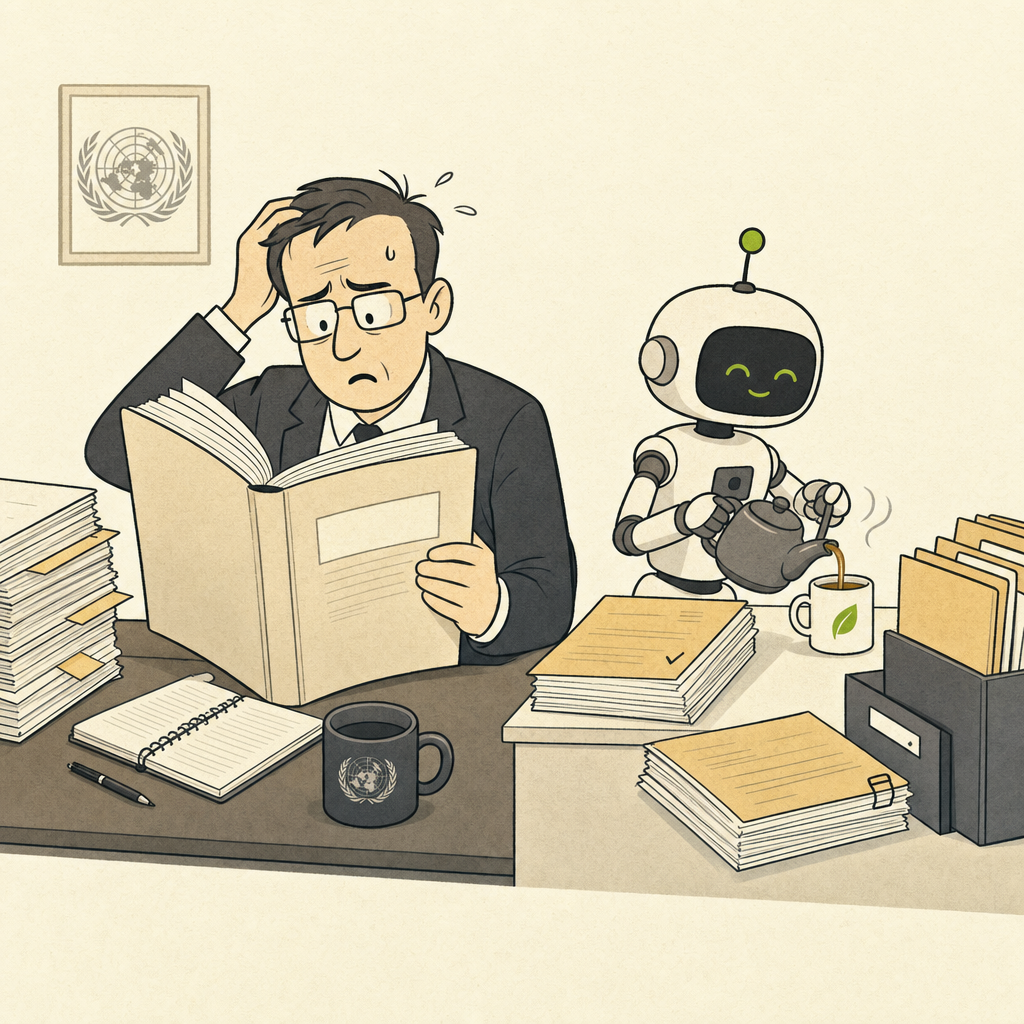
Finnwood's position on this is straightforward, and we are going to state it without a qualifying clause in sight: this is the single biggest medium-term story in business, and the firms who treat it as an IT project will be overtaken by the ones who treat it as a business strategy question. The IT department cannot answer "which of our roles is most exposed to this, and what do we do about it?" That is a conversation about your business model, your people, and your competitive position — and it needs to happen in the boardroom, not the server room.
The data from closer to home makes the urgency uncomfortable. The British Chambers of Commerce, working with the University of Essex, has been tracking how UK firms are actually moving on this. AI adoption among SMEs has accelerated rapidly, rising from 25% in 2024 and 35% in 2025 to 54% in 2026. Most of those firms are using generic tools — a chatbot here, a writing assistant there — and for now, more than nine in ten SMEs using AI report it has had no impact on workforce size over the past year. That is the reassuring headline. Here is the less reassuring one. Around one in ten firms have moved beyond generic tools into deeper, bespoke AI integration, and it is in this group that the economic consequences are already showing: approximately one fifth report staffing reductions attributable to AI, and bespoke AI adopters are roughly three times more likely to have restructured job roles. The firms furthest along the adoption curve are the ones already reshaping their workforces. The ones still on generic tools are, to a great extent, in the same position as a man using a slightly faster typewriter while the person in the next office quietly retrained as a typesetter.
The UN report suggests this technological shift could fundamentally reshape the future of work across industries — from journalism and accounting to law, software engineering and customer service. That is not a list of exotic professions. That is, more or less, the functional structure of a mid-sized Yorkshire business. The accountant, the marketing coordinator, the HR manager, the person who handles customer queries and writes the responses — AI is moving from systems that generate outputs and dialogues towards systems that act, and those roles sit directly in its path. The question is not whether the technology will affect them. The question is whether your business will be the one directing that change, or the one catching up to it two years late with a panicked budget line and a consultant flown in from somewhere expensive.
And government, it is worth saying plainly, is not going to ride to the rescue in time. The UN report notes that more than 40 AI governance frameworks and ethical guidelines already exist worldwide, yet remain fragmented, inconsistent, and rarely tested to see whether they work. Many safety assessments are still run by the very companies building the technology. Somewhere in Brussels, a man in an expensive gilet is drafting a clause about agentic AI oversight — and the fourth draft won't land before the technology has lapped him twice. Waiting for a framework to protect you is not a plan. It is the glass-walled office with the telephone.
The right move — and we have been saying a version of this since we wrote about AI tools and faster vans — is to treat this as the business strategy question it actually is. Map which parts of your operation are exposed. Identify where agentic AI creates genuine opportunity to expand what your existing team can achieve, rather than simply reduce it. Decide that deliberately, on your own terms, before a competitor or a cost crisis decides it for you. That distinction between leading the change and reacting to it is worth more than any particular tool or platform you might buy.
Jeff Tracy, as I recall, never waited for the forms to be countersigned. He had a plan, a capable team, and the sense to act before the situation became irretrievable. The man on the telephone is, in this reading of events, still on hold — and the rocket is a speck on the horizon. If you want to work out which side of that window your business is on, come and talk to us. We will not make you fill in a form. We will make you a brew, ask the right questions, and help you build a plan before the ground starts moving.